If millions of robots work for us, what network will handle payments for the value they create—and who will own that value?
That question suggests a possibility: could Physical AI produce a new asset with an impact comparable to Bitcoin's?
For now, I call it Proken: Productivity Token.
By the next Bitcoin, I mean a network asset that might change economic coordination. I am not predicting Bitcoin-like price returns, nor suggesting that issuing a robotics token would confer the same standing.
My hypothesis is that reliably measured physical work could support new financial infrastructure for trading, financing, and sharing machine productivity.
Bits did not automatically become Bitcoin
Numbers let people express quantities, bits let machines encode information, and the internet lets information circulate. But reproducible information does not itself create a scarce asset.
Bitcoin combines cryptography, a transaction ledger, proof of work, and network consensus to address transaction ordering and double spending without a central bookkeeper.Bitcoin white paper
The statement that crypto emerged in the age of bits is historical context, not a causal formula.
Likewise, a model token is a unit of content processing and carries no inherent asset rights. Model tokens and blockchain tokens share a name, but they are different things.
A more precise account of the path from numbers, bits, and tokens to Proken is this:
Having expanded our ability to express quantities, encode information, and call models, we are beginning to connect verifiable physical work to digital transaction networks.
What needs explaining is how completed work gives someone an economic claim that others can trust.
From buying machines to buying productivity delivered by a network
Communication networks offer a useful analogy. Bits and bytes were already used for information processing inside computers before the internet became widespread. Networking expanded the scale of information exchange across devices and organizations, and the scope for businesses built around connectivity, coordination, and service quality.
Ordinary customers buying communication services generally do not buy fiber, base stations, data centers, and satellites separately. They buy the connectivity those resources deliver together. A network organizes distributed equipment into a service customers can purchase with agreed quality commitments.
I believe Physical AI could follow a similar path: customers may move from buying an individual robot to buying an accepted task outcome delivered collaboratively by a robot network.
Consider an illustrative scenario: a hotel buys “complete cleaning of the common areas before seven every morning, subject to agreed acceptance criteria,” rather than procuring cleaning robots, transport equipment, scheduling software, charging, and maintenance separately. Equipment and systems from different suppliers could collaborate under operator authorization and safety constraints, with a service provider accountable for the overall delivery.
Multi-robot collaboration already has research and applications. The future hypothesis here is its development into an open service network spanning brands and operators, where customers can buy productivity jointly delivered by several participants. Whether that network emerges still depends on interoperability, service reliability, and organizational costs.
Once tasks span independent businesses, the network must establish who accepted the task, who delivered each part, who accepts the result, who bears responsibility for failure, and how revenue is allocated. A single company can use internal scheduling and accounting; transactions across operators require shared task descriptions, evidence, and settlement rules.
This is the starting point for Proken—Productivity Token: exploring how verifiable machine productivity could be purchased, exchanged, and settled across a collaborative network. Customers could buy services through a common entry point while the network allocates revenue according to accepted results and handles rework, default, and disputes. This remains a mechanism to test.
A common settlement instrument does not make all labor measurable in one physical unit. Cleaning, transport, and inspection require their own quantity, quality, timing, and acceptance standards; prices can then express exchange value. The need for common transaction rules does not automatically establish the need for a separate token. Fiat currency or stablecoins could still handle payment.
The first question, therefore, is whether productivity can be bought reliably as a network service. The next is whether Proken should take the form of service credits, a settlement instrument, or a native network asset. Its case must rest on making collaboration across operators more reliable and less costly.
What would Proken holders actually own?
At least four different things are easily confused.
First, a work record. One hundred accepted transfers create a verifiable fulfillment record. It proves what happened. A service already consumed cannot automatically serve as a reserve that someone can redeem again.
Second, a future service credit. A holder can redeem service under agreed location, time, and task conditions. What matters is who honors it, whether capacity is sufficient, and how failures and defaults are handled.
Third, a network token. It might pay network fees, provide collateral, or enable governance. Its necessity depends on whether it improves on existing payment and coordination methods.
Fourth, an asset or income right. A holder has a claim involving robots, an operating business, or distributed income. This needs enforceable legal arrangements; a number in a wallet cannot replace contracts and asset registration.
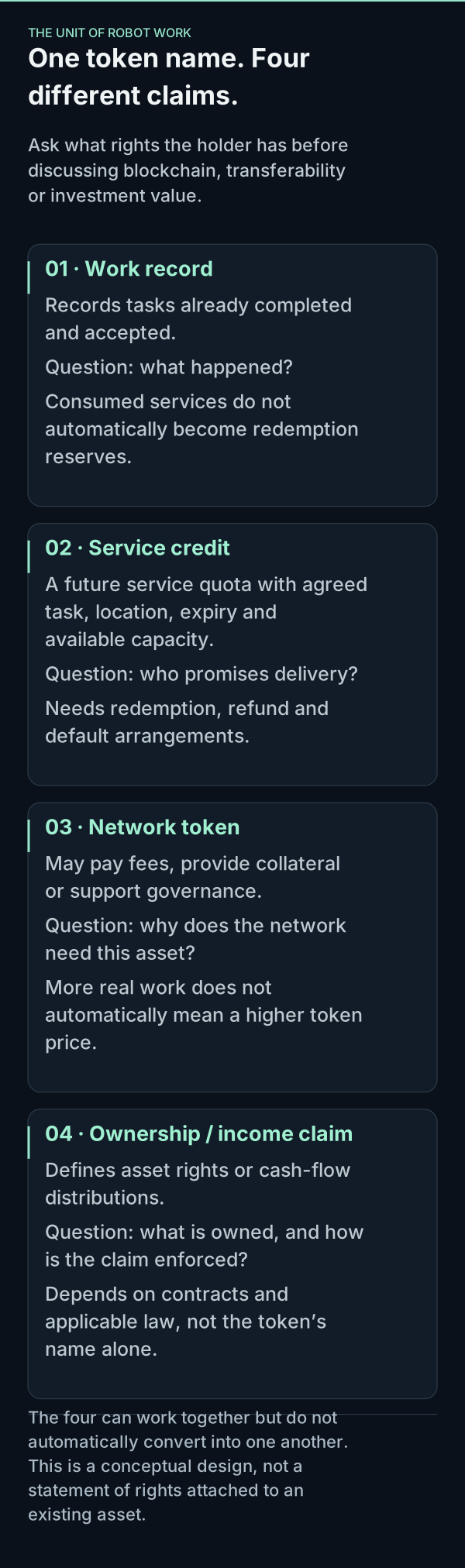
These four can coexist in one ecosystem, but calling all of them productivity-backed money obscures their differences.
If Proken becomes a virtual currency or cryptoasset, it must specify its layer and explain why people would keep holding, accepting, and using it.
Others are already connecting the robot economy with crypto networks.
Work on this is already under way.
Fabric Foundation's 2026 ROBO design addresses network fees, participation incentives, and governance. Participation in that coordination network does not confer robot hardware ownership or income rights. XMAQUINA explores collective governance and capital organization around robots and related assets. These official materials show that such combinations are being attempted, not that the assets will succeed.Fabric · XMAQUINA
Proken's contribution should therefore go beyond the idea that robots can have tokens too.
It needs to address a harder question:Can different devices, operators, and customers agree reliably and cheaply enough on what work has actually been completed?
Proving work is harder in the physical world
Bitcoin's proof of work establishes that protocol-defined computation occurred. It does not prove a room was cleaned or goods arrived intact.
Physical tasks depend on sensors, logs, customer confirmation, and third-party acceptance. Data can be wrong, customers and operators can collude, and tasks can be fabricated to collect rewards.
A blockchain can preserve submitted records but cannot, by itself, establish that real-world evidence is true. This is the central difficulty of bringing physical-world data on-chain.Ethereum: Oracles
A credible Proken network needs task identity, delivery evidence, spot checks, dispute handling, and accountable parties. Verification must also cost less than the transaction value it enables.
Payment and completion must remain distinct. Fabric's RoboPay documentation retains the robot controller's final safety authority: verified payment is not unconditional permission to act.RoboPay documentation
Payment, authorization, execution, acceptance, and settlement are five separate steps.
The strongest objection: why not dollars or stablecoins?
That objection deserves a direct answer.
If ordinary money can buy robot services and a database can record the work, a separate volatile asset may simply add conversion, accounting, and operating costs.
A robot can use payment systems with its operator's authorization. It need not first become an independent legal person to pay for charging or maintenance.
Whether Proken needs a native token therefore depends on showing that guarantees across operators, coordination, open participation, or governance require a mechanism existing solutions cannot readily provide.
Without that case, Proken could still be valuable as a common task credential and settlement interface. Payment could use fiat currency or stablecoins.
Render offers a useful reference: a network token and dollar-denominated work credits can occupy separate layers. Its work credits are nontransferable. Stable customer pricing and the price of an incentive asset can be designed separately.Render's official explanation
More productivity does not automatically raise a token's price
More machine work initially means greater service supply. Prices may fall and consumers may benefit.
Token holders face other variables: issuance, velocity, fees, value distribution, competition, and the rights they actually hold.
A fast-growing robot network could use a stable settlement unit, or earn profits for providers, without creating sustained demand for a particular network token.
Conversely, issuing extra tokens for every task without growth in genuine paying demand could dilute existing holders under the banner of productivity growth.
A record of completed work tells us what was delivered. Cash flow tells us about the business. Token value depends on asset design and demand. We still need to explain how the three connect.
My forecast: trusted work markets before new asset classes
I prefer to describe the future as testable stages.
The starting point is a change in what customers buy: a reliable outcome delivered by a collaborative network, with clearly assigned responsibility for fulfillment.
First, industries develop reusable specifications and acceptance methods for specific tasks.
Then, different brands and operators deliver under those rules, and customers buy across platforms.
As demand for future capacity, performance guarantees, and financing grows, new financial instruments may emerge around work transactions.
Only with a sufficiently open network, substantial real demand, and a native asset performing a hard-to-replace role could Proken develop from a proposed mechanism for trading machine services into an important network asset.
Supporting evidence would include recurring paying customers, independent acceptance, enforceable redemption arrangements, and demand that survives without token subsidies.
Evidence against it is equally clear: persistent incompatibility, excessive verification costs, subsidy-driven returns, or ordinary payment tools already doing the job well enough.
Physical AI may produce a major new asset class. Its prospects depend on more than robot counts: strangers must be able to trade real work with confidence.
If Bitcoin made us reconsider digital scarcity, Proken's question is how verifiable machine productivity could become something more people can buy, finance, and share.
Even a successful network would not make rising asset values benefit everyone automatically. The next essay turns from trading networks to distribution: whose accounts receive the wealth machines create?
Does the machine economy most need a new currency, or trustworthy standards for work and rights?
Publication and revision history
· Original Chinese essay first published on AINEMA.
· English edition first published on AINEMA.
· Added the communication-network analogy and the shift from buying equipment to buying collaborative outcomes; clarified task measurement versus settlement, and revised the conclusion. Chinese and English editions updated together.