
Anthropic's Most Important Customer May Be Itself
When Claude starts building Claude, a different kind of corporate competition begins to emerge.
AINEMA · November 25, 2026
01 | A Number More Interesting Than the Stock Price
On November 19, Anthropic made its Nasdaq debut. Less than a week later, its shares fell below their US$83 IPO price.[5]
Wall Street is recalculating its valuation. Technology journalists are comparing Claude with ChatGPT. Investors are debating who will ultimately win the AI race.
But in Anthropic's prospectus, there is a number that may be more interesting than its share price.
250 times.
Between January and September 2026, the list-price value of Anthropic's internal use of Claude increased more than 250-fold. In April, that monthly value first exceeded personnel expenses excluding stock-based compensation.
This is neither actual spending by Anthropic nor revenue from selling services to itself.
Yet it reveals a fascinating business phenomenon.
Other companies buy Claude to become more productive. Anthropic also uses Claude to become more productive at creating Claude.
The prospectus disclosed two other remarkable figures:
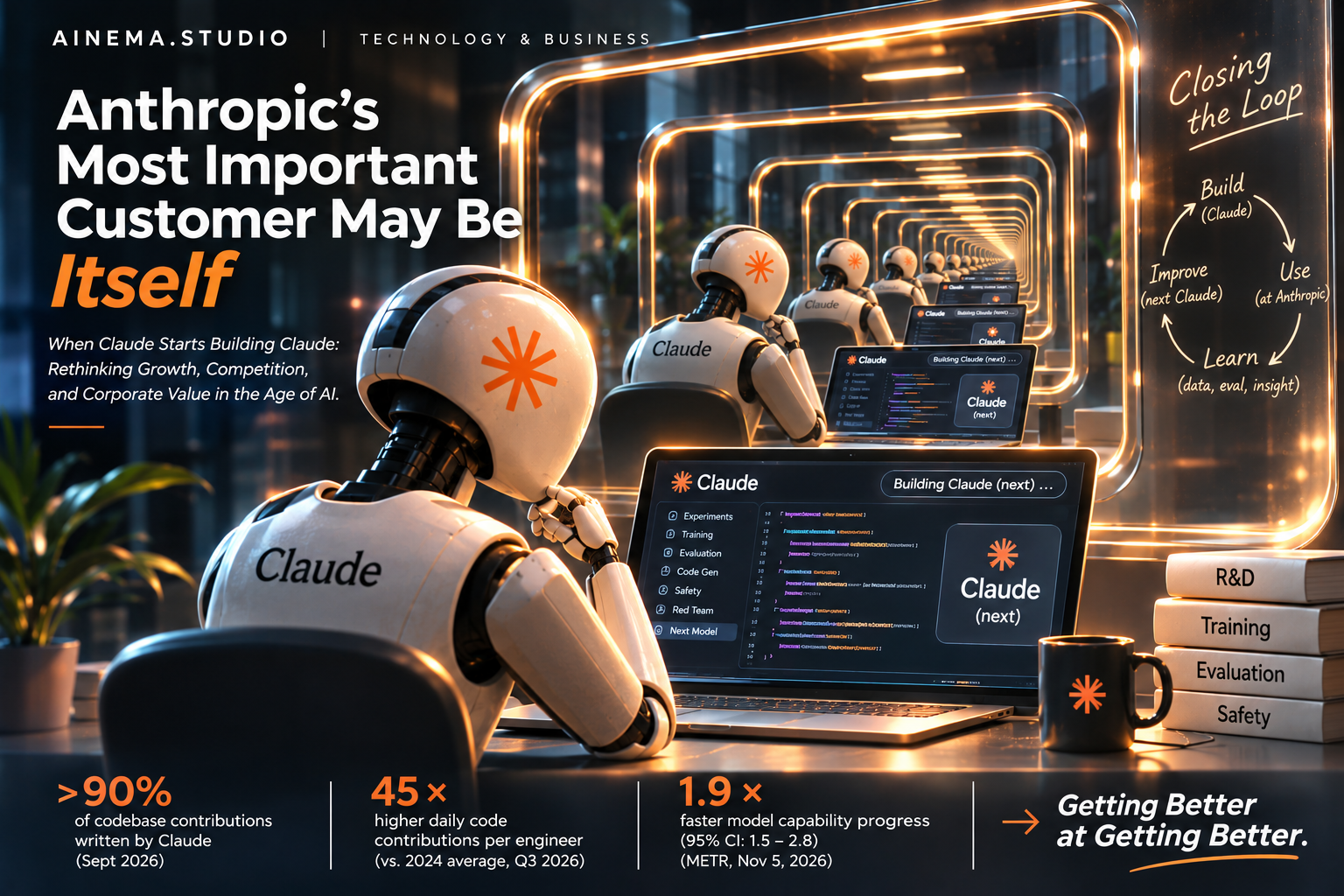
- Claude wrote over 90% of the contributions to its codebase in September 2026.
- In the third quarter of 2026, average daily code contributions per engineer were more than 45 times their 2024 level.
Forty-five times the code output does not mean forty-five times the research productivity. What matters even more than the volume of code is what that code is being used to do.
From experimentation and training-data work to software engineering, safety audits and model evaluation, Claude is becoming part of the process through which its successors are developed.
Claude is helping build the next Claude.
Anthropic calls this Closing the Loop.[1]
When computing capacity is constrained, Anthropic has at least two potential uses for additional capacity.
It can serve external customers and generate revenue today. Or it can support internal research and help create a more capable Claude tomorrow.
The former generates current commercial returns; the latter may strengthen the company's future earning power.
The interesting question is which use of incremental computing capacity creates greater long-term value: serving customers or developing more powerful intelligence?
When intelligence itself becomes a commodity, deciding how to reinvest it could become a new art of capital allocation.
02 | ByteDance and Anthropic: Same Idea, Different Game?
Being your own customer is hardly a new business strategy.
Amazon's experience with infrastructure challenges helped inspire AWS.
ByteDance uses Lark to address internal collaboration needs and has commercialized accumulated technological capabilities through Volcano Engine.[7–8]
The technology industry has a wonderfully strange term for using your own products: dogfooding.
It is a powerful strategy. Rather than relying entirely on market research to understand customer problems, you begin as a real customer yourself.
But Anthropic's story may have another chapter.
Imagine a company manufacturing electric drills.
If it uses those drills to renovate its offices, it is its own customer.
If it uses them to manufacture better drills, its products become means of production.
If each new generation also improves how its successors are designed, manufactured and tested, something more interesting begins to happen.
ByteDance illustrates how internal capabilities can become products others want to buy.
Anthropic is exploring how products can become tools for creating stronger capabilities.
These mechanisms can coexist, but they are not identical.
The product is no longer simply the outcome of innovation. It becomes an input into the next cycle of innovation.
03 | What If Optimus Starts Building Optimus?
Move this idea from the digital world into the physical one.
Imagine Tesla eventually producing 10,000 Optimus robots and deploying them throughout its factories.
Some manufacture cars.
Others help assemble, inspect, test and maintain robots.
Their work generates operational data, manufacturing knowledge and records of failure. Engineers use that knowledge to train and validate more capable robots.
Those robots can then contribute more substantially to the development and manufacture of their successors.
Each robot could generate two kinds of output.
The goods it produces today.
And the productive capabilities it helps create for tomorrow.
The most valuable job a robot ever performs may not be manufacturing a car, but helping manufacture a better robot.
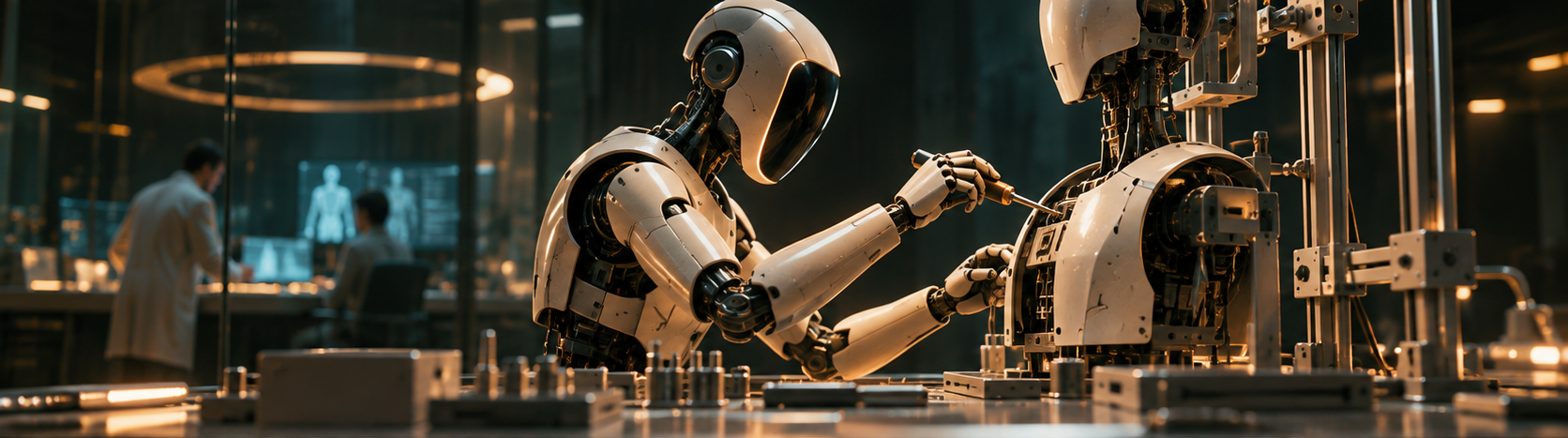
Concept illustration, not a photograph of a Tesla factory.
This is a thought experiment, not an established Tesla achievement.
Materials, mechanical wear, supply chains and safety requirements constrain the physical world. Manufacturing a robot does not automatically teach it anything.
Nevertheless, a related mechanism already exists in semiconductors.
Google DeepMind's AlphaChip has contributed to the physical layout of multiple TPU generations, while TPUs provide important computing infrastructure for AI.[6]
Use intelligence to create better computing.
Use better computing to create better intelligence.
Since the Industrial Revolution, humanity has been building increasingly sophisticated tools.
Now we are exploring how those tools can participate in creating their successors.
04 | A More Interesting Kind of Compounding
Wall Street believes in compounding.
Capital generates more capital. Knowledge helps us acquire more knowledge.
But what happens when the ability to innovate itself begins to compound?
I call this mechanism Capability Compounding, and use the term Recursive Enterprise to describe a company that deliberately develops it.
The idea has substantial intellectual foundations.
Kenneth Arrow explored the economics of learning by doing in 1962. Paul Romer developed a theory of endogenous technological change in 1990. David Teece and his colleagues introduced the dynamic capabilities framework in 1997, examining how companies renew their capabilities in changing environments.[9–11]
What AI potentially adds is a more direct role for products themselves in the reproduction and improvement of productive capabilities.
Imagine two technology companies starting with identical resources, technical capabilities and six-month development cycles.
The first maintains that pace.
The second improves its development tools and processes after each iteration, shortening every subsequent cycle by 20%.
| Time | Constant cycle | Progressively shorter cycle |
|---|---|---|
| 6 months | 1 iteration | 1 iteration |
| 12 months | 2 iterations | 2 iterations |
| 18 months | 3 iterations | 4 iterations |
| 24 months | 4 iterations | 7 iterations |

Two companies begin with the same capabilities. Two years later, they have completed different numbers of development cycles.
This is an illustrative calculation, not a forecast. Real research cycles cannot shrink indefinitely, and not every iteration delivers equal value.
But the example illustrates a different competitive dynamic.
The difference between two companies may lie not only in their rate of progress, but in their ability to improve that rate.
Capital compounding changes the speed at which assets accumulate.
Capability compounding could change the speed at which companies create assets.
The most interesting kind of growth may be growth in the capacity to grow.
05 | The Problem With Infinite Mirrors
Place two mirrors opposite each other, and you create the illusion of an infinite space.
Each mirror reflects the other, producing a seemingly endless sequence of images.
But real mirrors do not reflect light perfectly. Every reflection loses some energy. The deeper the image, the dimmer it becomes.

Recursive growth faces a similar problem.
The existence of a feedback loop does not mean it is strong enough to sustain continuous acceleration.
A July 2026 working paper, The Economics of Recursive Self-Improvement, featured by Stanford's Digital Economy Lab, examines this question.
Its preliminary calculations suggest that current feedback loops may not yet sustain self-reinforcing acceleration, although they appear to be strengthening.[4]
AI may write code faster without proportionally reducing chip fabrication lead times.
It may generate experimental proposals faster without making those experiments more valuable.
It may increase research output while increasing the burden of verifying that output.
On November 5, independent research organization METR estimated that, since October 2025, Anthropic's model capabilities on a particular benchmark index have been improving at 1.9 times their previous rate, with a 95% confidence interval of 1.5 to 2.8 times.[2]
This is noteworthy evidence, but it does not demonstrate fully autonomous recursive improvement. Causal attribution remains uncertain, and much of the important underlying evidence is unavailable publicly.
There is another reason for caution. Two facing mirrors repeat not only the light but also the imperfections.
If the first mirror is distorted, subsequent reflections may reproduce the distortion.
Recursive enterprises face a similar risk.
A flawed metric, a biased training dataset or an insufficiently tested technical judgment may be amplified in the next iteration.
The stronger the recursive mechanism becomes, the more important independent validation and correction become.
Infinite reflections do not imply infinite energy. A company that can amplify itself must also become increasingly good at correcting itself.
What matters is not an infinite loop, but continuous, validated improvement.
06 | Not Every Flywheel Is Recursive
Almost every technology company seems to have a flywheel these days.
More users generate more data. More data improves the product. Better products attract more users.
But I find it useful to distinguish three mechanisms of organizational improvement.
| Mechanism | Core logic |
|---|---|
| Internal use | Use your own products to improve operational efficiency |
| Feedback | Use knowledge generated through product use to improve the product |
| Recursion | Use existing products and capabilities to improve the mechanisms that create their successors |
These mechanisms can coexist. They are not necessarily sequential stages every company must pass through.
The defining feature of recursion is that it improves not only the product, but the process through which the product is improved.
And it need not be restricted to AI companies.
A pharmaceutical business could automate drug discovery while improving its discovery methods.
A manufacturer could use automated equipment to produce more advanced automated equipment.
A software company could use existing software to develop, test and optimize its successors.
An investment research organization could use analytical tools to improve its own research and validation methods.
The opportunity is to establish a durable cycle: create value, acquire knowledge, strengthen capabilities, and then improve the mechanism for creating capabilities.
To evaluate whether that cycle works, start with a simple question.
After each innovation, what tools, knowledge or methods has the company acquired that can help it innovate again, beyond the new product itself?
Companies should design not only their products and business models, but also their mechanisms of evolution.
07 | What If Every Competitor Can Use Claude?
Here is the strongest objection to the idea.
If Anthropic can use Claude to accelerate research, other companies can also buy access to Claude, Gemini or competing AI systems to improve their own research capabilities.
Does capability compounding represent a proprietary competitive advantage for Anthropic, or a productivity dividend available to the entire industry?
Imagine a software company cutting its development cycle in half through AI.
That sounds impressive.
But if every competitor also cuts its development cycle in half, the entire industry has accelerated together.
The company's relative competitive position may remain unchanged.
A productivity dividend is not necessarily a competitive advantage. An accelerator available to everyone is not necessarily anyone's moat.
This brings me to a third concept: Recursive Advantage.
Capability compounding is a company's internal mechanism of growth.
Recursive advantage is a commercial outcome relative to competitors.
Between them lie barriers to imitation, resource constraints, business models and the ability to capture value.
Such an advantage might arise from proprietary research data, unique experimental environments, difficult-to-replicate workflows or more efficient computing infrastructure.
It may also come from a superior ability to validate discoveries, discard errors and manage risk.
If competitors can rapidly reproduce every improvement, even an impressive self-improvement mechanism may fail to generate durable excess returns.
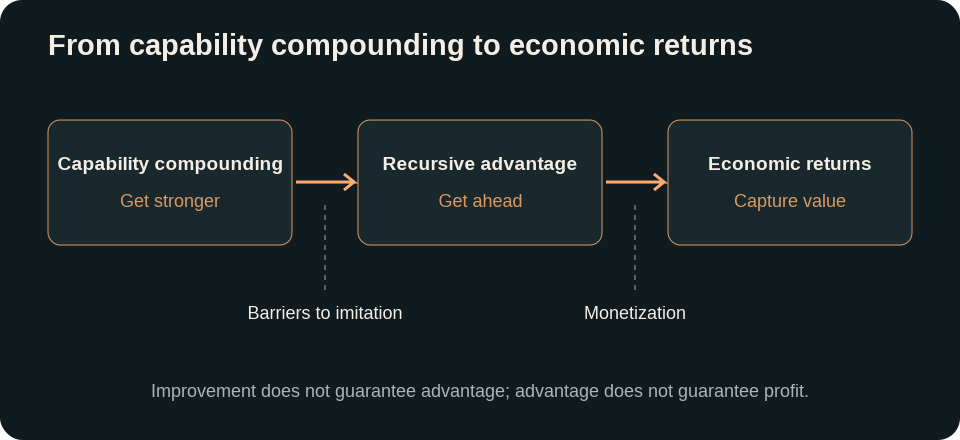
Getting stronger is a capability. Getting stronger faster than your competitors may be an advantage. Turning that advantage into profit is a business.
08 | How Is Wall Street Pricing the Ability to Evolve?
On November 18, Morningstar published its investment analysis of Anthropic.
Its analysts identified the ability to use existing models to develop subsequent models as one of Anthropic's important intangible assets.
Yet the same report assigned the company a very high valuation uncertainty rating.[3]
| Valuation scenario | Value per share |
|---|---|
| Bull | US$188 |
| Base | US$92 |
| Bear | US$25 |
A difference of more than sevenfold between the bull and bear scenarios for the same business.
Even when professional investors recognize Anthropic's technical capabilities, substantial uncertainty remains about the economic value those capabilities will ultimately produce.
Alongside conventional investment research, I believe five additional questions deserve attention:
- To what extent can today's products accelerate the development of tomorrow's products?
- Are development cycles shortening without sacrificing quality?
- Is the company producing more validated innovation per dollar of R&D?
- How easily can competitors reproduce these improvements?
- Can technological progress ultimately translate into customer value, profits and free cash flow?
This is not a new stock valuation formula. It is a set of questions for investigating long-term competitiveness.
The rate of technological evolution must be considered alongside its cost.
If an AI company requires ever-increasing capital expenditure and energy consumption to sustain technological progress without generating corresponding economic returns, a technological virtuous cycle can coexist with a financially destructive one.
A great company is not necessarily a great investment.
Capability compounding deserves attention. Price still matters.
09 | Getting Better at Getting Better
Is Anthropic truly its own most important customer?
We do not yet have enough evidence to reach a definitive conclusion.
But the value of that question extends far beyond Anthropic.
We have traditionally judged technology companies by the sophistication of the technologies they possess.
Perhaps we should also judge them by the sophistication of the mechanisms through which they create technology.
Capability Compounding is the underlying economic mechanism.
The Recursive Enterprise is the organizational form.
Recursive Advantage is the potential commercial outcome.
We have traditionally searched for companies with durable moats.
Perhaps we should also search for companies that possess the ability to continuously deepen those moats.
The most powerful companies of the future may not be those that are already the strongest, but those that keep getting better at getting stronger.
Getting Better at Getting Better.
References and Further Reading
- Anthropic — SEC IPO Prospectus, November 2026, Closing the Loop
- METR — Independent Assessment of AI R&D Acceleration at Anthropic, November 5, 2026
- Morningstar — Anthropic IPO: Inside Morningstar’s Investment Analysis, November 18, 2026
- Stanford Digital Economy Lab — The Economics of Recursive Self-Improvement, July 2026, working paper
- Reuters — Anthropic Shares Fall Below IPO Price, November 24, 2026
- Google DeepMind — How AlphaChip Transformed Computer Chip Design
- AWS — Our Origins
- ByteDance — Products & Services
- Kenneth Arrow — The Economic Implications of Learning by Doing, 1962
- Paul Romer — Endogenous Technological Change, 1990
- Teece, Pisano & Shuen — Dynamic Capabilities and Strategic Management, 1997
This essay represents personal business research, not investment advice. Capability Compounding, Recursive Enterprise and Recursive Advantage are used as an integrated analytical framework without claiming academic priority. The Tesla scenario and development-cycle calculations are illustrative thought experiments. Images are conceptual illustrations, not photographs of actual deployments.