Generation is getting easier. What remains scarce?
From making a video to delivering, distributing, and earning from it: a fresh look at opportunities small teams can test in the US AI video industry.
Research snapshot: October 19, 2026 · Decision-making reference · Prepared from our discussion
01 / DECISION FRAMEWORK
The opportunity is a result someone will buy
A recurring customer problem, an available budget, and your ability to solve it reliably: this is closer to a business opportunity than technical difficulty alone.
Existing supply
Basic generation and conversion
Established suppliers already provide subtitles, dubbing, lip sync, editing, and general training videos. Simply reselling tool capabilities leaves you exposed to price pressure and platform upgrades.
Scarce capabilities
Delivery against clear standards
Understand the audience and industry, reduce rework, manage rights and versions, and take responsibility for delivery within an agreed scope.
Business validation
Orders and repeat purchases
First sell a clearly scoped project. Calculate its contribution after labor and rework, then look for a second order.
Verified background: IAB reports broad adoption of generative AI in video ad creative. Omdia forecasts approximately $1.5 billion in US microdrama revenue for 2026. The latter covers all microdramas, not AI-generated dramas alone.[1][2] Scarcity assessments, scores, and startup priorities on this page are analytical judgments.
02 / CORE CAPABILITIES
Five capabilities that remain hard to secure reliably
01
Understand audiences and make testable content decisions
Choosing a story, adapting a plot, and identifying its audience are harder than translating dialogue.
Who pays
Chinese content companies, smaller distributors, and brand content teams
What you sell
Cultural adaptation, genre selection, opening and pacing edits, and controlled audience tests.
First project
Choose an authorized work and compare subtitled, dubbed, and deeply adapted versions.
How to validate
Continued viewing, plot comprehension, paid conversion, and the complete delivery cost of each version.
Assets you can build
Genre expertise and version-performance data collected with permission.
Limits and risks Trailer click-through rates cannot substitute for paid performance. Without access to data, distribution capability is hard to build.
02
Deliver finished videos reliably across tools
One beautiful clip is not the same as delivering a batch on time, on budget, and to specification.
Who pays
Specialist equipment suppliers, corporate training departments, and production companies
What you sell
Multi-tool production workflows, integration of real footage, consistent terminology and characters, and version approval.
First project
Deliver 3–5 English demonstration or training videos for one product.
How to validate
Acceptance rate, revision rounds, direct labor hours, and a second batch of orders.
Assets you can build
Industry knowledge, customer assets, and repeatable delivery processes.
Limits and risks Models will improve; simply connecting tools is easy to replace. Safety procedures must rely on verifiable material and expert review.
03
Find semantic errors and follow them through to resolution
A valid file with fluent subtitles can still omit dialogue, mistranslate who is responsible, or use the wrong version.
Who pays
Localization teams, content studios, and corporate content operations
What you sell
Compare videos with approved scripts, glossaries, and previous versions; mark error timestamps, categories, and resolution status.
First project
Review a batch with human assistance and establish an error taxonomy the customer accepts.
How to validate
Reduce review hours at the same missed-error threshold, while tracking false positives, misses, and repair time.
Assets you can build
Authorized error samples, acceptance rules, and integration into customer workflows.
Limits and risks Traditional quality control already has established providers. Avoid broad claims that a tool can automatically judge artistic appeal.
04
Make the rights chain clear, traceable, and acceptable to buyers
Original footage, dubbing, music, likenesses, and adaptations may involve different rights. Buyers need complete documentation.
Who pays
Distributors, studios, brand procurement, and legal teams
What you sell
Rights registers, usage and territory records, expiration alerts, and delivery-document checklists.
First project
Include a rights record as a standard attachment to a content delivery.
How to validate
Documentation completeness, approval time, and traceable handling of expiration and withdrawal.
Assets you can build
Professional trust, continuously maintained rights information, and procurement processes.
Limits and risks Recording provenance does not guarantee copyright clearance. Liability and expertise requirements are substantial; avoid promising legal certification or unlimited guarantees at the outset.
05
Control distribution and obtain business feedback
A completed video still needs to be discovered. Traffic, retention, and payment involve costs and conversion losses.
Who pays
Content companies, short-drama operators, and brands with ongoing media budgets
Help a customer with existing channels test a few assets before building a large consumer platform.
How to validate
Acquisition cost per paying user, net receipts over a defined period, continued viewing, and cash payback time.
Assets you can build
Real channel relationships, customer trust, and usable business data.
Limits and risks Views alone cannot establish profit. Be cautious about pure revenue sharing or fronting ad spend before securing data access.
03 / VALUE-CHAIN COMPARISON
Crowded does not mean closed. Scarce does not mean easy to enter.
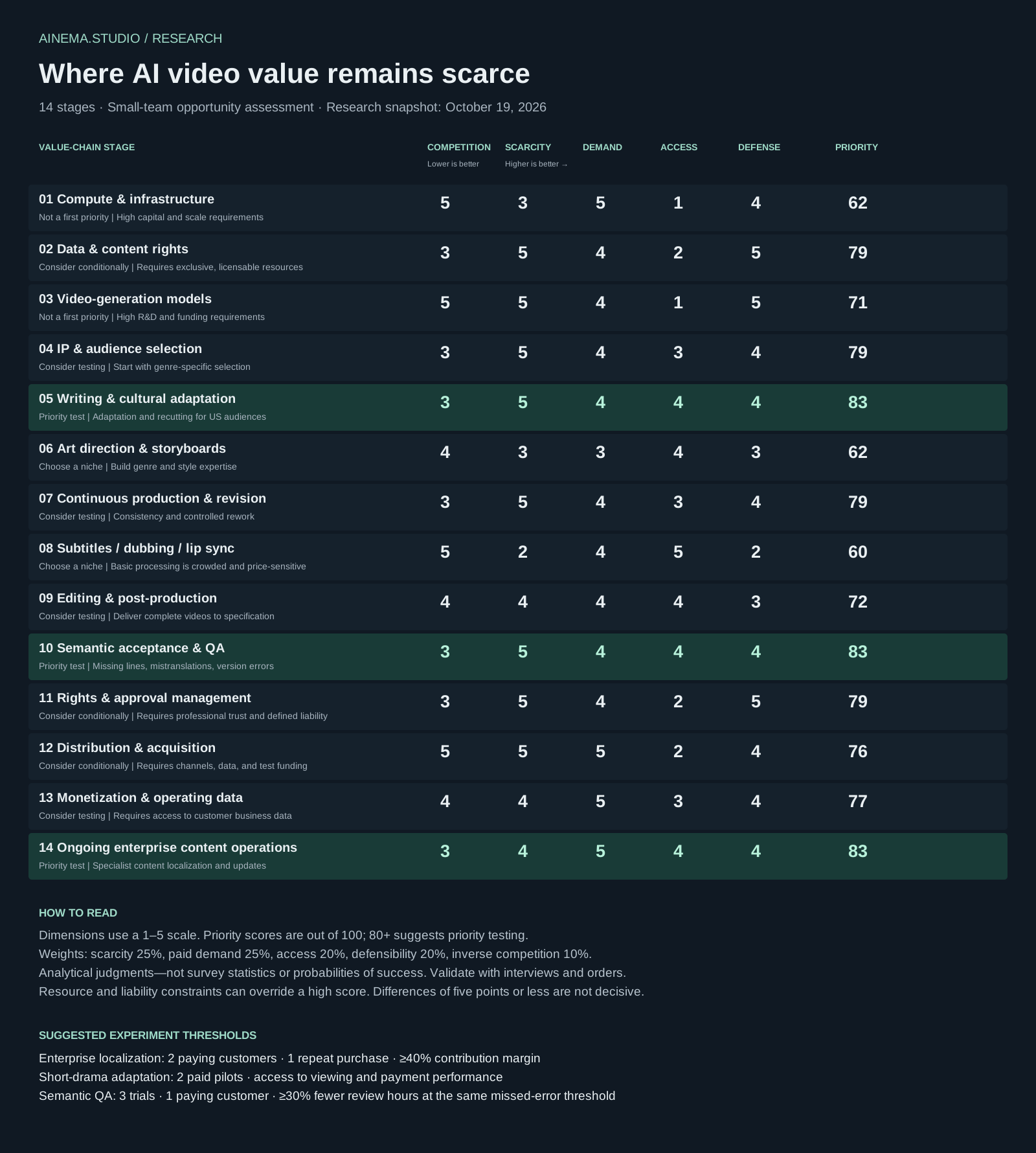
Each dimension is scored from 1 to 5. More competition is unfavorable; higher scarcity, willingness to pay, accessibility for small teams, and defensibility are favorable.
Analytical scores, not survey statistics; swipe horizontally on mobile
Value-chain stage
Competition ↓
Scarcity ↑
Demand ↑
Access ↑
Defensibility ↑
Priority score
Recommendation
01 Compute & infrastructure
5
3
5
1
4
62
Not a first priorityHigh capital and scale requirements
Not a first priorityHigh R&D and funding requirements
04 IP & audience selection
3
5
4
3
4
79
Consider testingStart with genre-specific selection
05 Writing & cultural adaptation
3
5
4
4
4
83
Priority testAdaptation and recutting for US audiences
06 Art direction & storyboards
4
3
3
4
3
62
Choose a nicheBuild genre and style expertise
07 Continuous production & revision
3
5
4
3
4
79
Consider testingConsistency and controlled rework
08 Subtitles / dubbing / lip sync
5
2
4
5
2
60
Choose a nicheBasic processing is crowded and price-sensitive
09 Editing & post-production
4
4
4
4
3
72
Consider testingDeliver complete videos to specification
10 Semantic acceptance & QA
3
5
4
4
4
83
Priority testMissing lines, mistranslations, version errors
11 Rights & approval management
3
5
4
2
5
79
Consider conditionallyRequires professional trust and defined liability
12 Distribution & acquisition
5
5
5
2
4
76
Consider conditionallyRequires channels, data, and test funding
13 Monetization & operating data
4
4
5
3
4
77
Consider testingRequires access to customer business data
14 Ongoing enterprise content operations
3
4
5
4
4
83
Priority testSpecialist content localization and updates
Scoring formula and limitations
Priority score = 5×scarcity + 5×paid demand + 4×accessibility + 4×defensibility + 2×(6−competition). The weights are 25%, 25%, 20%, 20%, and 10%, for a maximum of 100.
1 is low, 3 medium, and 5 high. Scores of 80 or more suggest priority testing; 65–79 suggest selective testing. Resource and liability constraints can override a high score. Differences of five points or less should not force a ranking. These are preliminary judgments for small teams, to be calibrated through interviews and orders—not probabilities of success.
Expand the complete scoring chart
04 / A CONCRETE CASE
Taking Chinese short dramas abroad: more than changing the language
Subtitling → dubbing and lip sync → cultural adaptation and distribution preparation → acquiring rights and distributing directly are four different businesses. Moving toward distribution may raise revenue potential, but also increases cash exposure, data requirements, and capability thresholds.
A / SUBTITLED VERSION
Keep the original picture and provide accurate, natural English subtitles. Test whether the target audience understands the story and keeps watching.
B / DUBBED VERSION
Provide natural English dubbing and basic audio processing. Measure whether the extra investment improves retention.
C / DEEPLY ADAPTED VERSION
With permission, rewrite dialogue, recut pacing, and adjust sound. Invest in lip sync only where needed.
Prioritize obtaining clean masters, scripts, character lists, and separate dialogue, music, and effects tracks. A mixed audio track alone raises repair costs. Giving characters English names is not, by itself, cultural adaptation.
Compare continued viewing, plot comprehension, paid conversion, and complete production costs. Assign versions across comparable audiences, channels, and campaign periods where possible, and record sample sizes. Otherwise, channel or audience differences may be mistaken for adaptation effects. More clicks do not necessarily mean more profit.
Interactive estimate: why can acquisition cost matter more than dubbing price?
This is a hypothetical scenario. Net receipts must use the same payback period and already deduct applicable platform and payment fees, refunds, tax treatment, contractual revenue shares, and other direct per-user costs.
Paying users needed to cover fixed investment2,500 users
Contribution per user: $4.00
A simplified model excluding unallocated overhead and the time value of money, not a revenue forecast. Net receipts and acquisition costs must refer to the same paying-user cohort and payback period. Acquisition spending must include traffic that did not convert, not just successful ads.
Initially, charge project fees to content companies or distributors with existing channels, then discuss transparent performance bonuses. Be cautious about pure revenue sharing or fronting ad spend without business-data access.
05 / CHOOSING A ROUTE
Test three routes first
REUSABLE SPECIALIST KNOWLEDGE
Enterprise video localization and updates
Buyer:Equipment suppliers, distributors, and training teams.
Delivery:Product demonstrations, training, glossaries, and version maintenance. Specialist accuracy is the differentiator; generic avatars are not a moat.
Suggested threshold:Two paying customers, at least one repeat purchase, and a contribution margin of at least 40% after direct delivery costs.
AN ENTRY POINT INTO ENTERTAINMENT
Adapting Chinese short dramas for US audiences
Buyer:Companies with content but limited local expertise, or channels but insufficient content.
Delivery:Adapted samples of the opening episodes, English finished videos, promotional assets, and rights documentation.
Suggested threshold:Two paid pilots with sufficient performance data; compare continued viewing and payment.
A POTENTIAL SOFTWARE OPPORTUNITY
Semantic video acceptance tools
Buyer:Localization teams and production companies.
Delivery:Script comparison, omitted-translation and consistency checks, timestamped reports, and resolution tracking.
Suggested threshold:Three trials and one paying customer; at least 30% fewer review hours at an equivalent missed-error threshold.
These are suggested experiment thresholds, not industry benchmarks. The enterprise route may fit robotics or equipment experience better, but existing relationships cannot be assumed to generate orders.
What do existing competitors mean?
HeyGen, ElevenLabs, and RWS already cover many localization tasks; Runway offers editing and workflows; Interra offers technical QA; TwelveLabs offers video understanding; Synthesia serves corporate training. The opportunity must address a specific customer, standard, and unresolved problem. Existing features should not be presented as an empty market.
Vendor documentation establishes that products exist, not that their delivery quality has been independently validated. Compare them using customer samples.
06 / FROM JUDGMENT TO EVIDENCE
Six weeks to a better-grounded choice
Weeks 1–2: Confirm the problem and budget. Interview content owners, distributors or operators, and specialist enterprise buyers. Find actual rework cases and the people responsible for purchasing.
Week 3: Produce authorized samples. Make one tightly scoped delivery for each route, recording all labor, tool costs, and revision time.
Week 4: Submit concrete proposals. Offer qualified customers a defined scope, price, deadline, and acceptance criteria. Observe whether they actually pay.
Weeks 5–6: Complete pilots and look for repeat demand. Compare delivery contribution, demand for a second batch, data access, and process reuse.
A suggested initial cash budget is $5,000–10,000 for editing, review, tools, necessary contract review, and samples. It excludes founder salaries, substantial minimum rights guarantees, full-series production, and large advertising campaigns.
Increase investment only after payment, positive project contribution, and demand for another batch. Without this evidence, adjust the scope and positioning first.
How could the original curated-short-film platform connect to these opportunities?
“Discover the world's most compelling next-generation short films each week, and meet their creators” could be a content-brand direction. But returning community members, repeat creator submissions, and commercial project orders are three different kinds of evidence.
Curated screenings can connect creators and buyers. Service revenue does not validate a consumer platform, and advertising-led expansion is premature without retention evidence.
07 / EVIDENCE & LIMITS
Sources and reading notes
Sources support the market context and existing product capabilities. The five-capability framework, startup rankings, quantitative weights, and experiment thresholds are analytical judgments that require validation through real customers, concrete proposals, and project results. This page is a research snapshot dated October 19, 2026; the principal market figures and listed product and copyright materials were rechecked on October 21. Product pages establish availability, not independently verified delivery performance or legal applicability.